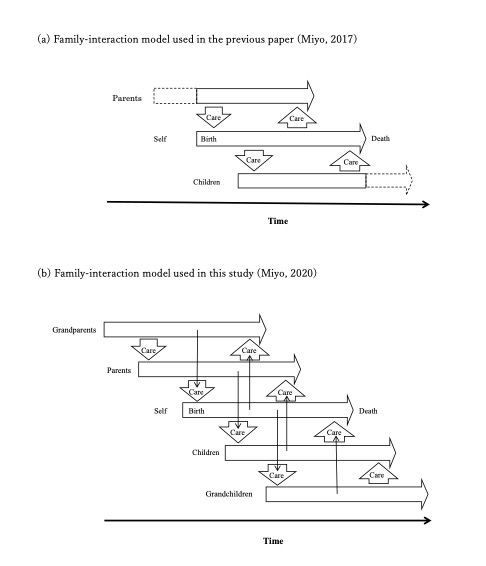
Thus, the evolutionary genetic models described so far have taken into consideration parent–offspring interactions—specifically, parental care for infants, which positively affects offspring survival and therefore the parents’ own fitness, and care for elderly parents by their adult children, which improves the survival of the elderly but may reduce the offspring’s fecundity. Particularly in Japan, where the declining birthrate and aging population have long been major concerns, we tend to focus on the enormous costs of caring for the elderly in everyday life. However, as suggested by the so-called "grandmother hypothesis," individuals who have passed their reproductive age can still transmit their genes indirectly to the next generation by enhancing the reproductive success of their younger relatives. In other words, even after the end of their reproductive period, elderly individuals may obtain an indirect evolutionary advantage through providing assistance to the younger generation. Therefore, I examined elderly care using evolutionary genetic models that incorporate not only parent–child interactions but also contributions involving grandparents and grandchildren. The effects of these intergenerational interactions are thought to become positive or negative depending on the circumstances at a given time (see figure below). In other words, as long as parents who have finished reproducing remain healthy, they can make a positive contribution to the next generation. However, this does not last indefinitely; as they age and their condition declines, they eventually enter a stage in which they themselves require care.
(translated version of the post on November 13, 2022)
このように、これまで述べてきた進化遺伝学的モデルは、親子間の相互作用に焦点を置いてきました。特に、子供の生存率に対してポジティブな効果をもたらし、それゆえ親自身の適応度にもポジティブな効果を及ぼすと考えられる親による乳幼児の養育と、年老いた親に対してポジティブな生存効果をもたらすものの、子供の繁殖に対してはネガティブな産仔数の効果を及ぼす可能性がある子供による高齢者の介護について考慮してきました。特に少子高齢化が叫ばれて久しい昨今の日本では、私たちは日常生活において、高齢者介護の莫大なコストに、より注意を向けがちではありましたが、いわゆる“祖母仮説”から期待されるように、繁殖期を過ぎた高齢者は、より若い近親者の繁殖成功に対する寄与を介して、間接的に自分自身が持つ遺伝子を次世代に寄与することができる、すなわち、繁殖期を過ぎたあとでも、若い世代に対する援助を介した間接的な進化的有利性があると考えられます。それゆえ、ここで親子間の相互作用だけではなく祖父母と孫からの寄与もまた含めた進化遺伝学的モデルを用いて、高齢者の介護について考察を行いました。祖父母や孫を含む家族メンバー間の相互作用の効果は、時間的な状況に依存して、ポジティブもしくはネガティブとなると考えられます(下図参照)。つまり、繁殖を終えた親が元気なうちは、次世代に対してポジティブな寄与を行うことができますが、それは永遠には持続するものではなく、やがて老化し衰えていくにしたがって、介護が必要な状況へと移行していくことになると考えられます。
(2022年11月13日のポストを再掲)