祖父母から寄与を引き出すこと (Some considerations on care of the elderly, using evolutionary genetic models)
祖父母から寄与を引き出すこと (Some considerations on care of the elderly, using evolutionary genetic models) · 29日 3月 2026
Likewise, if we assume that the long post-reproductive lifespans of older people evolved as a consequence of their contributions to the reproductive success of their offspring, then it may be reasonable to think that human child-rearing is so demanding that it can be carried out only when the presence and assistance of grandparents are presupposed. Recently, there has been considerable discussion about the difficulties faced by young mothers who are left to raise their children alone, including...
祖父母から寄与を引き出すこと (Some considerations on care of the elderly, using evolutionary genetic models) · 28日 3月 2026
Although dementia is already a major concern and is projected to become even more serious in the near future, analyzing it in the context of environments to which humans have adapted over evolutionary timescales may yield insights that help improve elderly care. For example, many hypotheses have been put forward regarding the possible influence of natural selection—one of the primary forces driving evolutionary change—on Alzheimer’s disease. The idea that Alzheimer’s disease is a...
祖父母から寄与を引き出すこと (Some considerations on care of the elderly, using evolutionary genetic models) · 27日 3月 2026
According to the grandmother hypothesis, the extended lifespan of older individuals beyond their reproductive years can be evolutionarily advantageous if it contributes to the reproductive success of their offspring, thereby increasing the transmission of their genes to the next generation. Therefore, broadly speaking, in species like humans—where older individuals with long post-reproductive lifespans exist and where extensive social interaction occurs across age groups—it may be said that...
祖父母から寄与を引き出すこと (Some considerations on care of the elderly, using evolutionary genetic models) · 26日 3月 2026
Current situations surrounding the elderly This study suggests that, despite the high costs of caring for elderly parents, the benefits that the elderly provide to the next generation are essential not only for the continued maintenance of such caregiving behavior within a population but also for the population’s growth. If this is correct, can we say that Japan—where population aging is steadily progressing—has succeeded in creating, or has at least attempted to create, an environment in...
祖父母から寄与を引き出すこと (Some considerations on care of the elderly, using evolutionary genetic models) · 25日 3月 2026
I submitted my previous paper on the evolutionary genetics of elderly care to an overseas open-access journal, and soon afterward I began receiving frequent emails from abroad encouraging me to submit papers to various other open-access journals. When submitting to a journal, there are often substantial costs, such as referee fees and processing fees, so for someone like me—writing papers as a citizen researcher while working part-time—the number of journals I can submit to is limited....
祖父母から寄与を引き出すこと (Some considerations on care of the elderly, using evolutionary genetic models) · 24日 3月 2026
Abstract of the submitted paper As in my previous paper, I examined both evolutionary genetic models that incorporate age structure and discrete-generation models that do not. In particular, the discrete-generation model requires a framework that preserves family structure, as it must account for contributions from grandparents and grandchildren. Consequently, I had to treat mating between many different family types separately. This is quite complex, so if you are interested, I would recommend...
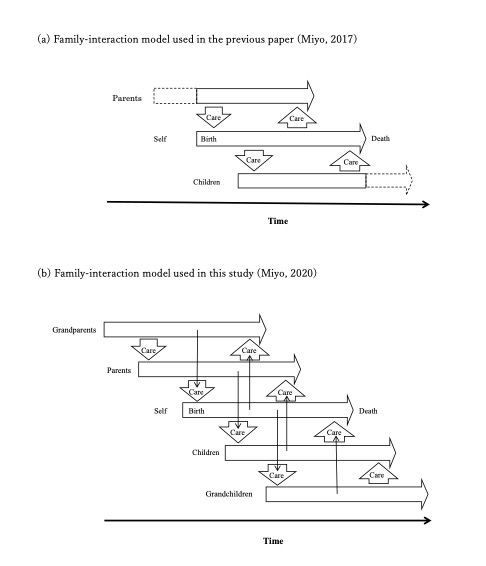
祖父母から寄与を引き出すこと (Some considerations on care of the elderly, using evolutionary genetic models) · 23日 3月 2026
Thus, the evolutionary genetic models described so far have taken into consideration parent–offspring interactions—specifically, parental care for infants, which positively affects offspring survival and therefore the parents’ own fitness, and care for elderly parents by their adult children, which improves the survival of the elderly but may reduce the offspring’s fecundity. Particularly in Japan, where the declining birthrate and aging population have long been major concerns, we tend...
祖父母から寄与を引き出すこと (Some considerations on care of the elderly, using evolutionary genetic models) · 22日 3月 2026
To illustrate the strength of the parent–child bond with a real example, evidence from certain utopian social experiments, such as the Israeli kibbutzim, suggests that disrupting this bond is intolerably distressing for most people and that it holds an essential place in the system of human desires. The kibbutz referred to here was a community formed during the movement to establish the State of Israel, organized around the principles of complete equality among members, mutual responsibility,...
祖父母から寄与を引き出すこと (Some considerations on care of the elderly, using evolutionary genetic models) · 21日 3月 2026
Models taking account of contributions from the elderly generation In my previous paper, I examined elderly care using evolutionary genetic models that assumed a strong connection (a pleiotropic constraint) between parental care for infants and the subsequent care provided to elderly parents once those children have grown up. Let me reiterate here that there is little doubt that, for children—especially infants—establishing a secure relationship with their parents has immense selective...
祖父母から寄与を引き出すこと (Some considerations on care of the elderly, using evolutionary genetic models) · 20日 3月 2026
That said, I think quite a few people have misunderstood or become confused about the relationship between the evolutionary genetics of elderly care that I have been examining and the well-known grandmother hypothesis. I believe that the distinction would have been clear if one had read the main text of the paper, but since most people are busy and do not have enough time to read it carefully, this may be unavoidable. However, the title of the paper I wrote in English might indeed have been...